Research
Working Papers
Learning the Major-Industry Mismatch
Abstract
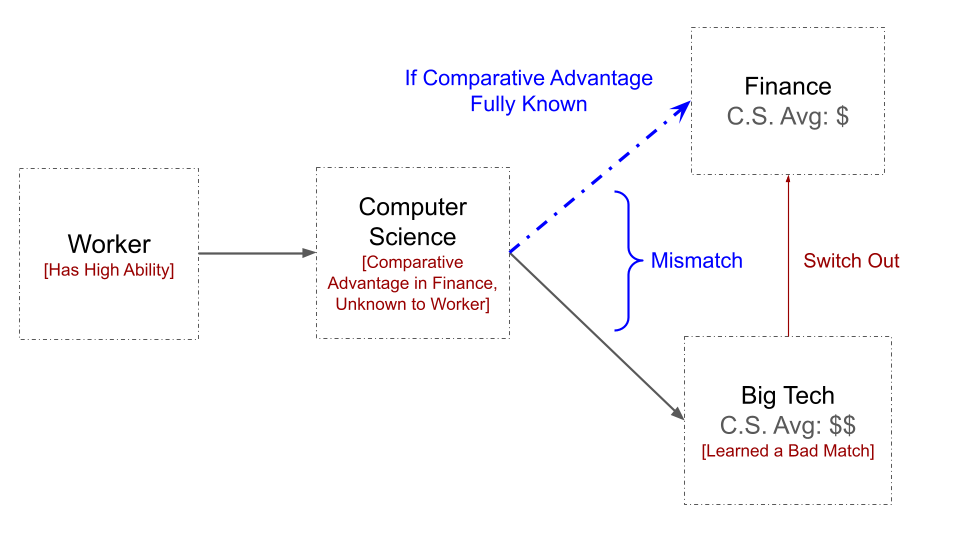
How do information frictions distort the choices of college majors and
industries? This paper argues that uncertainty about an individual's
major-industry fit is a primary driver of mismatch and earnings
dispersion among skilled workers. Using confidential Canadian
administrative data linking education and employment histories, I
establish three key facts. Firstly, mismatched individuals switch
industries more. Secondly, on-the-job learning about major-industry
match partially resolves the uncertainty. Thirdly, using a natural
experiment that leverages LinkedIn's entry into Canada, I confirm that
more information reduces mismatch. To quantify the aggregate
consequences of these frictions, I develop a life-cycle directed search
model with Bayesian learning where multidimensional skill individuals
choose majors, industries, and climb the job ladder within an industry.
The model is estimated to the Canadian economy and is consistent with
the empirical facts. Imperfect information steers graduates to suboptimal
majors, industries, and rungs on that ladder. Unresolved uncertainty
about outside options, combined with search frictions, makes mismatch
persistent. The model reveals that information frictions reduce average
output by 25% at labor market entry. Counterfactuals show that improving
the efficiency of this learning process not only raises aggregate output
but also triggers a significant reallocation of talent, as majors with
higher career uncertainty become more attractive.
Searching in the Housing Market with Non-Committed Prices
Abstract
This paper develops an equilibrium theory of matching between buyers and
sellers in the real estate market, especially investigating how partially
committed asking prices respond to the pool of prospective buyers
associated with each good. Buyers with heterogeneous financial abilities
visit based on expected gain, suggesting that the pool of prospective
buyers faced by the sellers depends on expected competition induced by
the asking price. In a search market with asking prices, I show
analytically that sellers optimally post lower asking prices when the
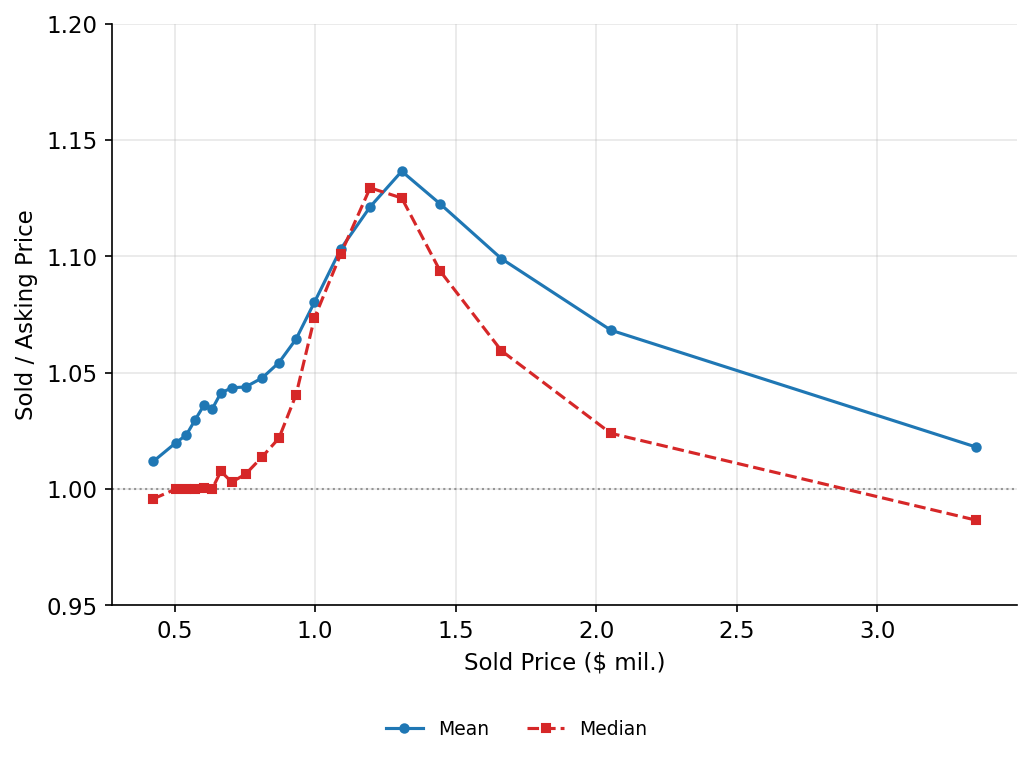
targeted market is more competitive. I also show that the model-predicted
sale-over-asking ratio is consistent with the empirically observed
evidence from the Toronto real estate market.
AI and Returns to Experience in Entrepreneurship
Abstract
Artificial Intelligence (AI) is reshaping returns to human capital. This
paper examines how AI affects the value of work experience in
entrepreneurship. Using employment histories from public LinkedIn
profiles (2007–2019), we exploit industry-level variation in AI exposure
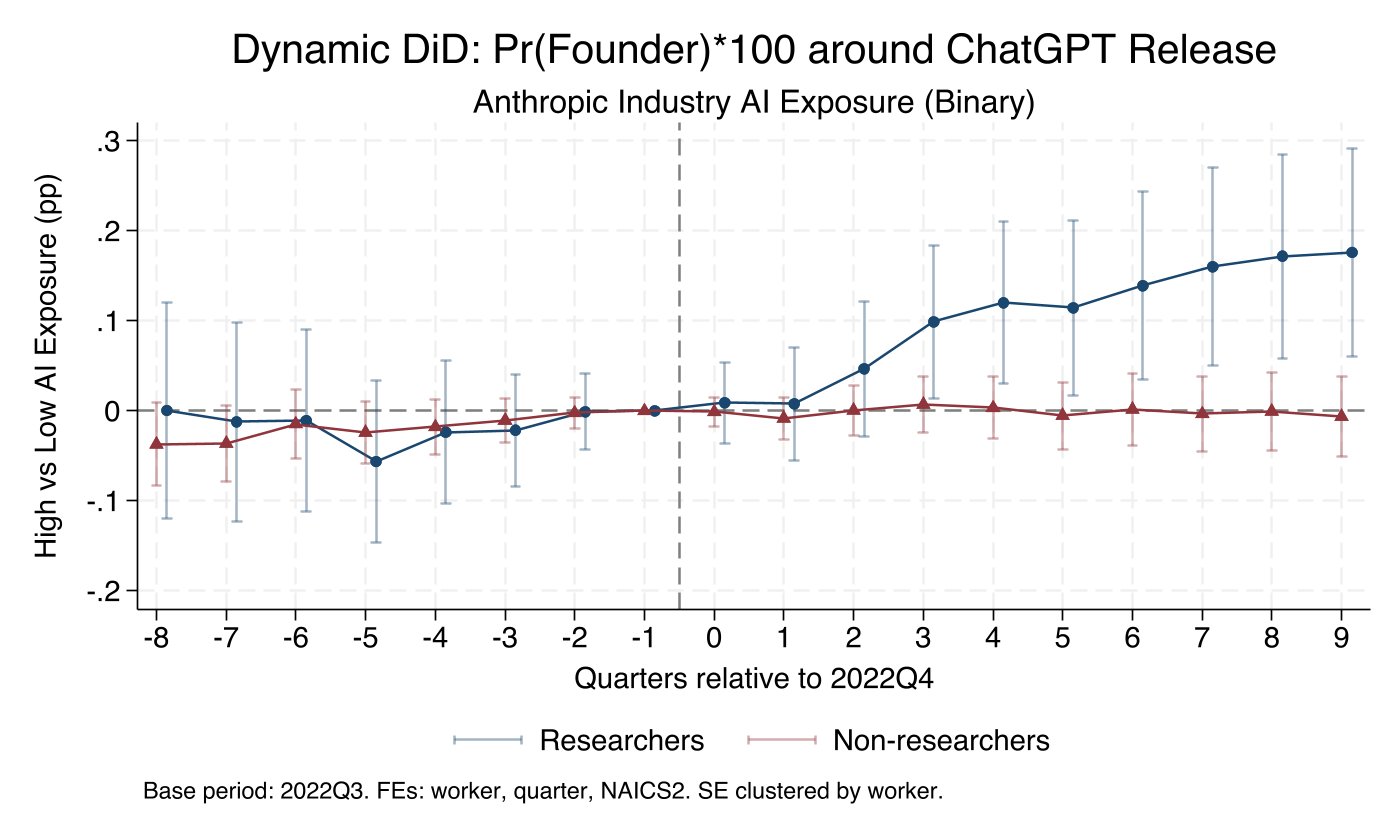
following the diffusion of neural networks and ImageNet after 2012. We
find that both the share of founders and researchers increased, but entry
gains were concentrated among more-experienced workers, especially those
with research backgrounds. To understand the mechanism behind AI's impact
on the labor market, we develop a directed search model with occupational
choice, multidimensional skills, and stochastic human capital investment.
The model shows that AI shocks increase the productivity premium for
researchers, shifting entrepreneurship toward more experienced
individuals.
Work in Progress
Safety Net or Trap: Informal Sector Employment over the Business Cycle
Abstract
The informal sector is often viewed as a buffer during economic
downturns, absorbing workers displaced from the formal sector and
mitigating unemployment spikes. Using panel data from Continuous
National Household Sample Survey (PNADC) between 2012 to 2018, we
examine the short- and long-term consequences of informal employment in
Brazil across the business cycle and establish several new empirical
facts. We observe that the informal sector expands during recession,
consistent with the literature, indicating that the informal sector acts
as a buffer for workers. Our new finding is that a brief spell in the
informal sector, lasting at most one quarter, increased the probability
of formal re-entry relative to unemployment. However, prolonged informal
employment sharply reduced re-entry probabilities into the formal sector,
with this scarring effect persisting after controlling for individual
characteristics.
To interpret these patterns, we develop a directed search model with human capital depreciation, where depreciation depends on employment type and spell length. The framework captures the observed dual role of the informal sector as both a short-term safety net and a long-term trap. When designing labor market policies, our findings show that "when" to act is as important as "what" to do. Preserving the short-term benefits of the informal sector requires timing as well as targeting, a dimension the literature has largely overlooked.
To interpret these patterns, we develop a directed search model with human capital depreciation, where depreciation depends on employment type and spell length. The framework captures the observed dual role of the informal sector as both a short-term safety net and a long-term trap. When designing labor market policies, our findings show that "when" to act is as important as "what" to do. Preserving the short-term benefits of the informal sector requires timing as well as targeting, a dimension the literature has largely overlooked.